‘Balthazar’ draws a bead on American gun culture
One can legitimately argue that there are two types of people: heroes and victims. And which one you choose to be indicates a lot about how you perceive the world and how it reflects you. It’s all part and parcel of a dichotomous symbiosis in which winners and losers conjoin in a shared demand for attention, like that hilariously on display in the intriguingly dark satire “Our Hero, Balthazar.”
It exists at the nexus of loneliness, anger and isolation, feelings exacerbated by the anonymity afforded by the double-edged sword of social media, a purported uniter that readily subjugates and divides. It’s also an astute study of opposites rooted in our nation’s growing disparities in wealth, opportunity and states of mind. For guinea pigs, the writing team of Ricky Camillari and first-time director Oscar Boyson call upon two gifted young stars in Jaeden Martell and “Hugo’s” Asa Butterfield to portray egregiously neglected teens at opposite ends of the social spectrum.
What fascinates isn’t their differences, but their commonalities. Both are ciphers exploiting the facelessness of the Internet to mask their insecurities behind boisterous alter-egos focused entirely on performance. For Martell’s titular Balthazar Malone, it’s publishing teary-eyed grief videos in which he pretends to be empathetic toward the survivors of school shootings. And for Butterfield’s Solomon Jackson, it’s about posting threats to carry out such a massacre.
For the sake of making their point, Boyson and Camillari improbably bring the two boys together, with Balthazar traveling from his mother’s Manhattan penthouse to the Texas trailer park where Solomon lives in abject poverty with his disabled granny (Becky Ann Baker). The contrasts are painfully obvious. And thankfully, the filmmakers don’t overplay them. Rather, they dwell on the unexpected kinship that develops between two friendless outcasts tethered to the common denominator of disaffection.
Yet their bonding is purely transactional. With Balthy, as he likes to be called, it’s a desire to play the hero by heading off Solomon’s evil intent to impress an activist classmate (exciting newcomer Pippa Knowles) who ghosts him after he attempts to seduce her with graphic footage of a school shooting. And for Solomon, it’s the prospect of winning the love of his absentee father (Chris Bauer) by unloading a lifetime supply of Pop’s testosterone-enhancing snake oil on the deep-pocketed Balthy.
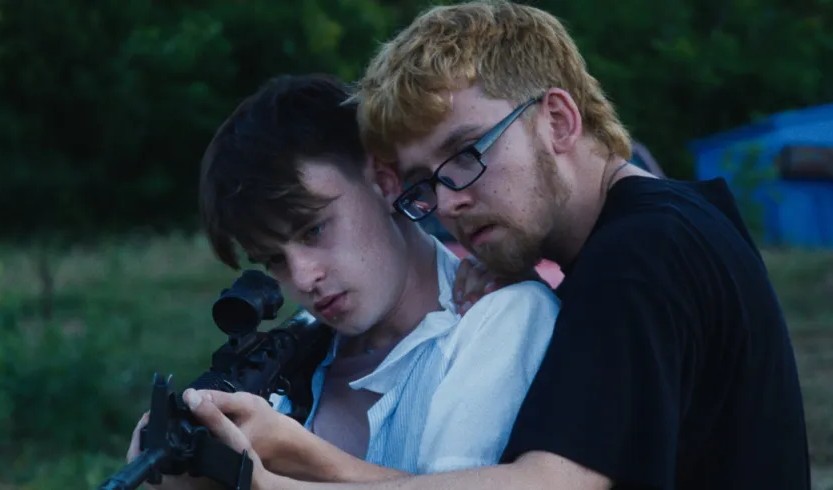
The homoerotic vibes blossoming between the teens are inescapable, particularly during bizarrely erotic scenes of the two bonding over a growing fixation with Solomon’s arsenal of semi-automatic weapons. Both are obviously sex-starved, what with Knowles’ Eleanor outright rejecting Balthy’s advances and Solomon being correctly labeled an incel by his former co-worker, Taylor (Anna Baryshnikov), after he regales her with TMI concerning his ex-porn star father’s junk.
I know, none of this sounds rife for laughs. But Boyson, a producer on the Safdie Brothers’ masterpieces “Good Times” and “Uncut Gems,” maintains an absurdist tone that slyly keeps the farcical grounded in the reality of a generation of angst-ridden adolescents growing up inundated by fear and despair. Much of it fostered by irresponsible adults too preoccupied with themselves to notice how scared shitless their children are of a world where they’ve irresponsibly been taught almost everything is a potential threat. For Balthy and Solomon, it becomes a self-fulfilling prophecy.
Yet they are not alone in the expect-the-worst mindset bred by what Eleanor declares as a corporate initiative to entice “lonely, hopeless kids into an annihilation mentality.” And that’s what makes this potential cult classic such essential viewing. Well, that and the high level of artistry exhibited by Butterfield, and especially, Martell, very much a clone of a young Kieran Culkin. He’s outstanding at locating the emptiness and disillusionment that have robbed his Barthy of all semblances of self-awareness. And, boy, does he make it resonate.
I somehow overlooked this outstanding film when it hit theaters this past spring, but I’m thankful it’s getting a second chance, albeit only for one night (Thursday) before moving to streaming, where it hopes to find its target audience. And who is that target? To be honest, every parent and child over 17 drowning in the deluge of bloviating influencers and online predators looking out for everything but your child’s welfare. Ignore it at your peril.
Movie review
Our Hero, Balthazar
Rated: R for graphic nudity, drug use, crude sexual content, language throughout, some violence, a grisly image
Cast: Jaeden Martell, Asa Butterfield, Chris Bauer and Jennifer Ehle
Director: Oscar Boyson
Writers: Oscar Boyson and Ricky Camillari
Runtime: 96 minutes
Where: Returning to theaters for one day on July 23 before going to streaming on most platforms
Grade: B+