‘Shake Your Booty!’ dances into your heart
Quirky doesn’t begin to describe “Ha-Chan, Shake Your Booty!” It’s a comedy centered around a grief-stricken Tokyo widow trapped in a purgatory of her own design, one where joy and sorrow coexist alongside sexual longing. It features elaborate Bollywood-esque dance numbers interspersed among wacky flights of fancy, countering the air of unimaginable anguish surrounding the loss of the soulmate she assumed she’d grow old with.
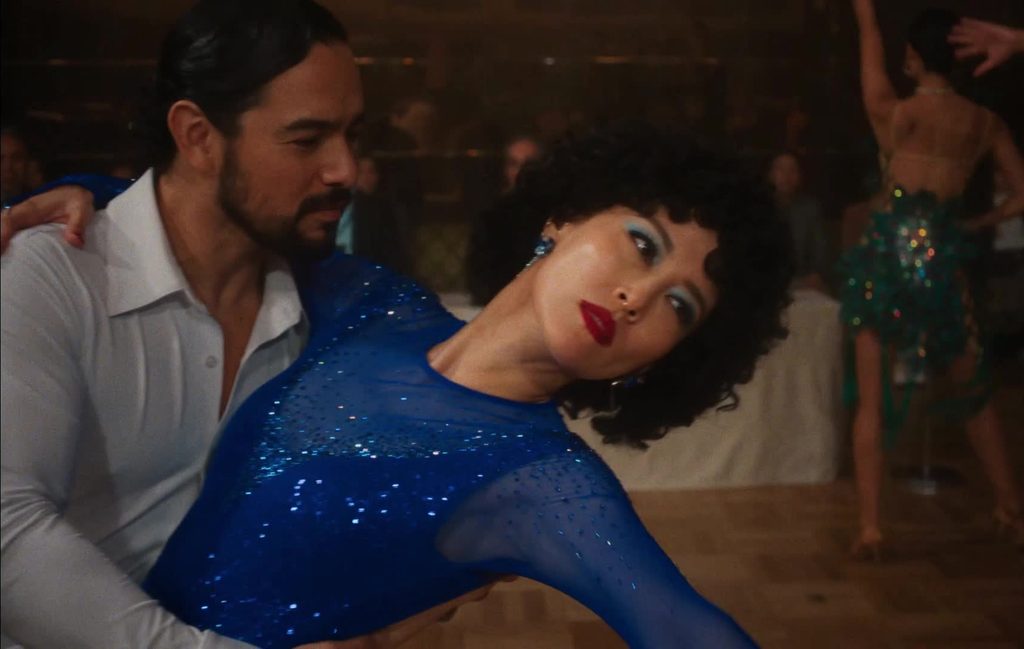
Beyond the unexpected humor, I found it incredibly moving, largely because Rinko Kikuchi strikes the perfect balance between eccentric hilarity and wrenching heartache. Her Haru even looks a bit clownish beneath her poofy afro-style perm and vivid red lipstick, and when called upon to deliver doses of Lucille Ball-inspired slapstick, she seldom disappoints. You simply cannot help being smitten.
Director Josef Kubota Wladyka and co-writer Nicholas Huynh take full advantage, capitalizing on her irresistible charm in a clear attempt to gloss over the lack of depth, most apparent in the nonexistent backstories that would help us better understand Haru and the folks in her immediate circle. It’s clear that Haru is utterly devoted to her Mexican-born hubby Luis (Alejandro Edda), but how and where did they meet? And when and where did they become so consumed by ballroom dancing that they dine on home-cooked Mex-Asian entrees while watching videos of their competitions and critiquing their performances?
We also meet Haru’s staid sister, Yuki (Yoh Yoshida), and sex-crazed divorcee cousin, Hiromi (You), who rush to her side in the wake of Luis’s shocking death. How significant are they in Haru’s life? Were they always as supportive as they are in Haru’s darkest hour? Still, you welcome their presence as a brutally frank Greek chorus, urging Haru to take baby steps as mourning gives way to wild nights on the town. It begins with Yuki and Hiromi dragging Haru to a dance class led by the hunky new instructor, Fedir (Alberto Guerra), an international hoofer who gained popularity via viral videos of him and his gorgeous wife, Mila (Keren Louis), tripping the lights. And, more provocatively, for their well-publicized open marriage.
As you’d expect, Haru is instantly smitten, especially because he’s a Latino as handsome and debonair as Luis, who, apparently stuck in limbo, still visits Haru from time to time in a ridiculous, oversized raven costume. In true Lucy Ricardo fashion, Haru amiably lies and deceives to get exactly what she wants: a night out with Fedir that ends under the covers. And if she succeeds, the hope is she’ll be freed from the prolonged melancholia precipitated by Luis’s death. What she doesn’t expect is post-coital guilt. Is it a betrayal? Or might Luis’s apparition willingly join them in an unorthodox ménage à trois?
Finding out is almost as fun as savoring the numerous dance sequences, topped by an impromptu bachata in front of Tokyo’s Ueno Station that begins with a violent altercation before evolving into a full-blown Busby Berkley production. DP Daniel Satinoff shoots it all with invigorating vibrancy and a fanciful “Amelie” flair that keeps the mood light and airy, despite our underlying dismay at Haru’s inability to accept that at age 46 her life is far from over.
Whether Haru is cutting the rug with Fedir or Luis, the sexual tension is palpable, as is the fire Kikuchi and Guerra stoke, with every delicate touch or movement calculated to turn up the heat. Both are so convincing – imbuing grace, elegance and eroticism – you’d never guess they’d never danced the rumba, tango, or cha-cha-cha before. Ditto for the supporting players.
As good as they all are, Kikuchi (an Oscar nominee for “Babel”) shines brightest. Whether she’s dancing up a storm or engendering genuine empathy, Kikuchi renders Haru the epitome of class and beauty, even when disguised under layers of ghostly makeup as La Catrina, in step with an eventful finale rooted in the traditions of Mexico’s Día de los Muertos (Day of the Dead).
Wladyka credits his 81-year-old mother, still an avid ballroom dancer, as his inspiration for “Ha-Chan,” which he adoringly dedicates to her. You can sense that love and devotion in every frame, as he honors both her and his mixed Polish-Japanese heritage with a scrumptious display of multiculturalism, be it through dance or an eclectic soundtrack that includes everyone from Peanuts (“Una Sera Di Tokyo”) to Cranberries (“Dreams”).
As they say, music is the language of the soul, and this expression is essential to almost every scene, beginning with Haru’s vast vinyl collection, which fills an entire wall inside her suburban ikkodate. And you wish Wladyka, who won best director at the most recent Sundance Film Festival, had dug a little deeper into Haru’s powerful attachment to music as well as her love of dance.
The shortfall is almost as frustrating as Wladyka’s decision to needlessly divide his film into six “chapters,” with each title tiresomely read aloud first in English and then, overzealously, in Japanese. But that’s a mere nitpick in an otherwise endearing flick that does its utmost to be the hope-ium crowd-pleaser it so desperately wants to be.
Movie review
Ha-Chan, Shake Your Booty!
Rated: R for sexual content and language
Cast: Rinko Kikuchi, Alberto Guerra, Alejandro Edda, Yoh Yoshida, You and Keren Louis
Director: Josef Kubota Wladyka
Writers: Josef Kubota Wladyka and Nicholas Huynh
Runtime: 122 minutes
Where: In theaters Sept. 25
Grade: B