Magnificent ‘Mouse’ gives good grief
Spielberg excels at stories about other worlds, while his good buddy, Marty, specializes in La Cosa Nostra. For Kelly O’Sullivan and Alex Thompson, their forte is grief: how it changes you, opens new doors and unleashes strength you never knew you had. It also makes you wiser, even if you’re only 17, like Minnie, the remarkable heroine of “Mouse.”
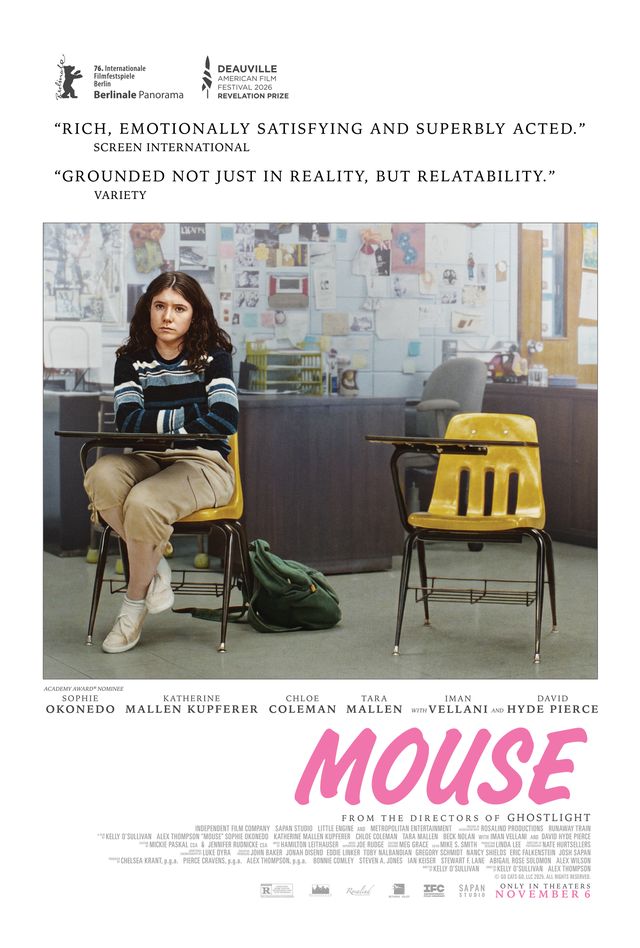
From the get-go, it’s clear there’s nothing mini about Minnie, even though she’d beg to differ. She’s quiet, shy and woefully deficient in self-confidence, the math wiz more comfortable behind the camera than in front of it. She’s also the sort the mean girls pounce on like a lion on fresh meat. But she has something they don’t. That being Callie (Chloe Coleman), the star of their junior class. She, a gorgeous Broadway headliner in the making, and Minnie, her biggest fan, are the bestest of best friends, something everyone knows but precious few choose to acknowledge. They tell themselves they’re Callie’s ride or die, not Minnie, played with exceptional maturity and even more astounding relatability by Katherine Mallen Kupferer.
We witness their closeness early on. It’s the last day of their junior year in sleepy Little Rock, Arkansas. It’s 2002 and summer beckons, along with adulthood. To celebrate, Callie’s proud parents, Helen (an outstanding Sophie Okonedo) and Mark (Christopher R Ellis), throw a to-die-for slumber party, capped off by Callie belting out show tunes for her performing-arts peers. A beaming Helen accompanies her on piano, herself a one-time virtuoso who traded her shot at success to become something better: being Callie’s mom.
When it’s time to send the boys home and the girls to bed, Callie and Minnie steal away upstairs to end the special day alone; Callie uses the moment to share her dreams of conquering the Big Apple, ascending from starving artist to the second coming of Streisand. Minnie’s doubtful expression betrays an unspoken fear that her friend is setting herself up for disappointment. At the same time, Minnie finds Callie’s audacity infectious, especially as she possesses so little of her own.
Then IT happens. Walking home from her janitorial job the following day, Minnie encounters a handful of visibly shaken kids gathered on Callie’s front lawn. Soon after, a car containing Callie’s parents pulls up. They step out, clearly devastated, Sophie awash in tears. Callie has died. And so has a part of Minnie and Helen.
Three months later, the two awkwardly bump into each other in, of all places, the school-supplies aisle. Could this foster a beautiful friendship? You bet it does. But it could also prove toxic. Not just for them, but for Minnie’s mother, Barbara (Tara Mallen), a vet assistant who’s never been what you’d call a doting parent. She does her best on a meager salary, but she can’t compete with a woman as sophisticated and dignified as Helen, and, sadly, she knows it.
That’s the setup for one of the best movies of 2026, a triumph that balances healthy doses of humor with profound reflections on grief. Kinda like O’Sullivan and Thompson’s last directorial gem, 2024’s “Ghostlight,” in which a burly construction worker, played with precision by Keith Kupferer, processes his pent-up anguish by secretly joining a ragtag theater group, triggering suspicion on the part of his spouse and daughter, portrayed, respectfully, by Keith’s real-life wife (Mallen) and offspring (Mallen Kupferer). Seeing mother and daughter reunited not only enhances authenticity but also provides the connective tissue that links what I hope will become a trilogy on loss and renewal.
One also senses an autobiographical undertone in O’Sullivan’s script, given the film’s specificity to 2002 (Michelle Branch’s “All You Wanted” is prominently featured), as well as its astute insight into the heartbreak of losing someone, especially when that person was not just young and talented, but also a treasured friend. Or, as Minnie insists, “Not friends … BEST friends.”
Yes, there are a few coming-of-age tropes, including a first kiss from someone you’d least expect, but O’Sullivan’s script depicts these more as revelations. Nothing about it feels phony or contrived. It’s honesty throughout, starting with Kupferer’s breakout turn as a girl so recognizable you’d swear you knew someone just like her back in high school. You feel the enormity of Minnie’s loss in every frame. Ditto for Okonedo, who is resplendent in a role that fully taps into her broad range. Like Mallen Kupferer, this is Oscar-caliber work that transcends simple acting and approaches something closer to unadulterated truth.
The crowning jewel, though, is O’Sullivan’s flawless screenplay, which has the ingenious ability to leave you on the verge of tears one moment and laughing boisterously the next, all during the same scene. It also unexpectedly treats every character with kindness, even the “mean girls,” played by Audrey Grace Marshall and Addisyn Grace Cain. You and their teacher, Mr. Murdaugh (an impressive David Hyde Pierce), expect the interpretive dance they have planned for a revue honoring Callie to be a tone-deaf flop. So imagine the surprise when it becomes the most moving scene in a movie rife with them. And vice versa with Minnie, who works tirelessly with Helen to outshine Donna McKechnie’s stellar original Broadway version of “One.” Or, at least that was the plan.
I also appreciate O’Sullivan’s choice not to pit Helen and Barbara against one another in a Minnie sweepstakes, a decision that facilitates a compelling confrontation in which both moms comprehend what makes mothering most rewarding, even when that child is no longer with us. It tore at my heart like no mother-daughter movie I’ve ever seen.
That is why “Mouse” is bound to become a Mother’s Day staple that both moms and daughters can fully identify with. While watching, I couldn’t help but think of my own mother, who, like Barbara, must have felt slighted as I grew closer to my best friend’s mom than to her. I’m sure I’m not alone. I also suspect it happened to O’Sullivan. You detect it in the genuineness of the guilt and self-condemnation her characters harbor. They aren’t out to hurt others. They’re just hurting. And they don’t know how to make it stop.
Movie review
Mouse
Rated: R for language, teen drinking and some sexual references
Cast: Sophie Okonedo, Katherine Mallen Kupferer, Chloe Coleman, Tara Mallen and David Hyde Pierce
Directors: Kelly O’Sullivan and Alex Thompson
Writer: Kelly O’Sullivan
Runtime: 120 minutes
Where: In some theaters; goes wide Nov. 13
Grade: A