‘Bitter Christmas’ bears tidings of woe
The pretentious “Bitter Christmas” finds Pedro Almodóvar in a matryoshka-style mode, packing stories inside stories to diminishing effect. More gimmick than art, it features an Almodóvar surrogate so bereft of script ideas that, without asking, he pilfers his friends’ and colleagues’ very real tragic tribulations. None of them are happy about what they rightly see as a betrayal of trust.
Clearly, the 77-year-old harbors deep-seated guilt he seeks to alleviate on our time. But he overestimates our willingness to engage, making this one of the more disappointing entries in an otherwise robust oeuvre. The acting, as always, is superb, and the candy-colored visuals are an Almodóvar trademark, yet some of his most pedestrian storytelling lays it to waste.
It begins on a stormy Christmas in 2004. Elsa (a radiant Bárbara Lennie), a failed filmmaker who’s amassed a fortune shooting TV commercials, has taken to her bed, felled by a migraine exacerbated by what is later diagnosed as a panic attack. Her charming firefighter/exotic dancer boyfriend, Beau (hunky Patrick Criado), has doted on her all evening, sacrificing a lucrative stripping gig.
Jump cut to 2026, where we gaze upon the handsome face of a far more celebrated artist, middle-aged Raul Rosetti (Leonardo Sbaraglia), busily clacking away on his laptop. As he types, the words appear on the screen, and we soon realize Elsa isn’t real. Rather, she’s the protagonist in Raul’s next project. So, in essence, Almodóvar is writing about a writer writing about a writer writing about a writer. Happily, it’s not as confusing as it sounds.
What IS a glaring liability is Almodóvar’s failure to provide any incentive for us to invest in these paper-thin characters. Almost all of whom are well-off, self-involved high hats who spend their waking hours whining and complaining about how awful their lives are. Yes, melodrama has absorbed Almodóvar since he entered his 70s, with “Parallel Mothers” as the pinnacle and the insipid “The Room Next Door” as his nadir. “Bitter Christmas” falls neatly in between, a “minor work” as one character aptly puts it.
Naturally, a “minor” Almodóvar flick is better than 85 percent of what’s out there, but for him, the bar is higher, and this one disappointingly falls short. As I said, it’s not the fault of Lennie, who ably portrays a role that years ago would have been tailor-made for Almodóvar’s muse, Penélope Cruz. She has a certain allure, even when Elsa spends much of her screen time feeling sorry for herself.
Sbaraglia doesn’t make as memorable an impression, playing a part that, back in the day, would have gone to Antonio Banderas. Sbaraglia certainly fits the profile, but there’s little substance behind the gray beard and dispassionate eyes. He’s basically a cipher, a necessary cog in the clunky mechanisms of a movie that unfolds from his perspective. After all, he’s the puppet master, using his keyboard to control every twist and turn in his characters’ lives. So, imagine the frustration when he cannot do the same with the “real” people in his circle: his departing personal assistant, Mónica (Aitana Sánchez Gijón), and live-in boytoy and now Mónica’s replacement, Santi (Quim Gutiérrez).
Once the “help” realize their loyalty was one-sided, they understandably rebel, raising questions about the boundaries between authors and the lives of those who work under them. Should their inimacies be fodder for screenplays, even if their names are changed? That’s autofiction’s inherent quandary. When you “borrow” from yourself, as Almodóvar did with the magnificent “Pain and Glory,” the personal account is often praiseworthy for its raw honesty, opening the curtain to an artist’s soul. But when it’s another person’s experiences, ones relayed to him in strict confidence, a moral line is crossed.
That latter aspect obviously concerns Almodóvar, as well as Raul and, by proxy, Elsa, who, two decades after her last feature (now a “cult” classic), has suddenly caught the bug again. Her inspiration is facilitated by the rocky marriage of her dearest friend, Patricia (Victoria Leungo), and the debilitating grief plaguing her go-to ad star, Natalia (Milena Smit), still reeling from the recent death of her young son. Sure, Elsa is fictionalizing their stories, but what gives her the right?
When it comes time to answer that intriguing question, Almodóvar cops out, offering what feels like a nonchalant shrug. And that’s what makes “Bitter Christmas” so infuriating. You invest nearly two hours in characters who are, frankly, shallow and annoying, and this is all you get?
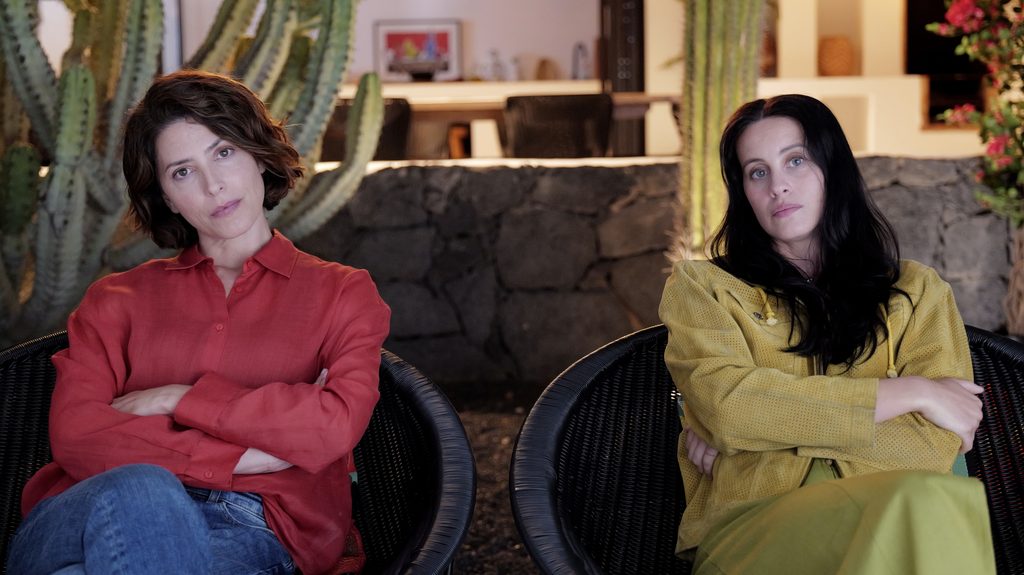
At least the film looks great, especially when it moves from wintry Madrid to the sun-drenched, volcanic landscapes of Lanzarote; its black-sand beaches and cactus gardens a feast for the eyes. But it’s also symbolic of a picture more about aesthetics than exploring the unsavory side of human nature. It’s almost poetic that it concludes with Elsa, like Almodóvar, alone on an island.
Movie review
Bitter Christmas
Rated: R for some sexual material and language
Cast: Bárbara Lennie, Leonardo Sbaraglia, Victoria Leungo, Aitana Sánchez Gijón, Milena Smit, Patrick Criado and Quim Gutiérrez
Director: Pedro Almodóvar
Writer: Pedro Almodóvar
Runtime: 112 minutes
Where: In theaters now, expanding Nov. 20 and 25
Grade: C