‘Dead Man’s Wire’ sets its sights on vigilante justice
Gus Van Sant is no stranger to the true-crime genre, with both “Drug Store Cowboy” and “To Die For” on his resume. In each of those acclaimed films, Van Sant displayed a knack for highlighting the absurdity, not to mention the audacity, of criminals who justify their lawbreaking through a lens clouded by hubris and narcissism. The director’s latest, “Dead Man’s Wire,” fits tightly into that niche, with its deranged protagonist brazenly taking a mortgage company exec hostage and demanding not just compensation for his financial losses, but also an apology for what he perceives has been “done to him.”
It’s set during the Jimmy Carter years, when real estate was booming and foreclosures were decimating the so-called “little guy,” as Indianapolis land speculator Tony Kiritsis prefers to think of himself. He built his dream around constructing a shopping center on a 17-acre tract west of the city. But many of his prospective tenants opted out, leaving him on the verge of bankruptcy. Instead of faulting himself or the location, he targets the folks at Meridian Mortgage, claiming they steered potential clients away from him and toward its own properties.
Kiritsis has no proof of this occurring, but it doesn’t stop him from taking matters into his own hands on the blustery morning of Feb. 8, 1977, when he enters the Meridian offices with the intent of kidnapping chairman M.L. Hall. But upon receiving the news that Hall is off sunning himself in Florida, Kiritsis instead snatches Richard Hall, M.L.’s son.
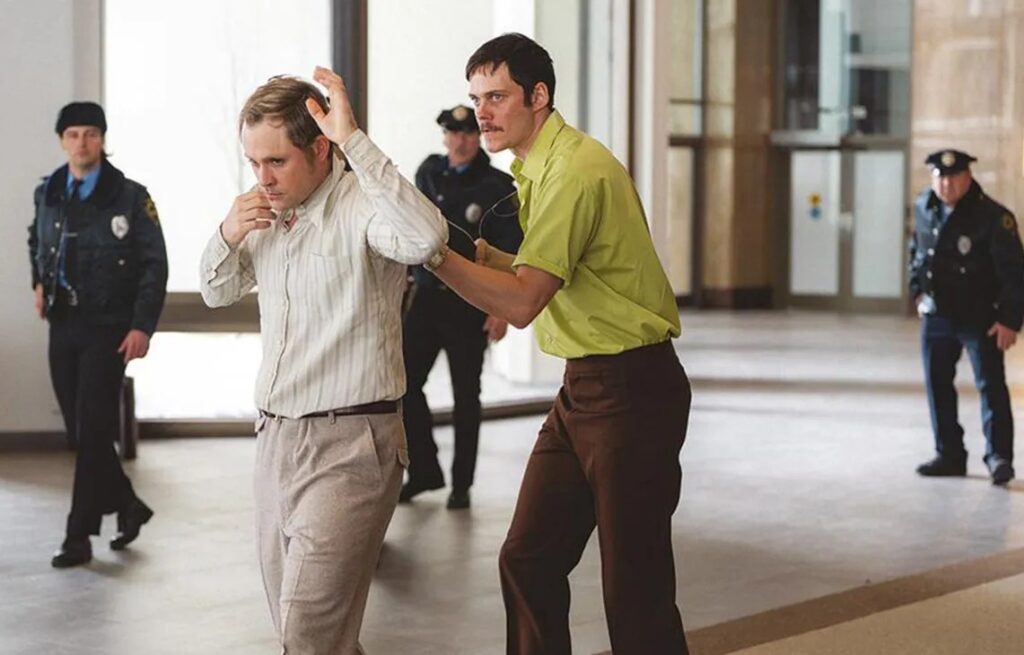
To ensure he can’t escape, Kiritsis wires a shotgun to the back of Hall’s head and rigs it so that if he dares attempt to flee, or the police shoot or tackle Kiritsis, the gun will blow Hall’s head clean off. It’s a crudely constructed contraption, but imposing enough to enable Kiritsis to march Hall through the streets of Indianapolis unimpeded in front of stunned onlookers before commandeering a police cruiser to transport Hall to his hidey-hole in the Crestwood Apartments.
Thus begins Van Sant’s seriocomic adaptation of Austin Kolodney’s fact-based script, which, rightly or wrongly, casts Kiritsis as an empathetic felon with no choice but to correct alleged injustices with the business end of a loaded weapon. If this reminds you of Sidney Lumet’s “Dog Day Afternoon,” that’s probably what Van Sant intended. As if you needed any additional signal, he’s slyly cast that masterpiece’s star, Al Pacino, as M.L. Hall. Per usual, Big Al (literally) chews the scenery in what amounts to a couple of bloviating cameos that help prop up a somewhat sagging midsection.
Not that Bill Skarsgård doesn’t do his damnedest to render Kiritsis a compelling embodiment of an aggrieved everyman who, ironically, is becoming increasingly unwired. It’s a fantastic depiction, complemented by an unfortunate avocado shirt and even sorrier-looking mustache. It’s no small feat that he elicits not just your sympathy, but that of an entire country on edge as the crisis plays out before a growing national TV audience. At one point, he even bumps John Wayne off the air during an awards ceremony.
Van Sant doesn’t bring anything particularly new to the table, including the battered one that Dacre Montgomery’s Richard remains bound to for hours on end. Predictably, he weaves in scenes of Kiritsis and Hall engaging in expository small talk that reveals each man’s hopes, regrets and disappointments. The implication is that if they weren’t both wired to a shotgun, they might grow to be pals. It’s a wonky form of Stockholm Syndrome that, unfortunately, extends to the audience.
Should we really be rooting for an armed maniac who is tying up valuable public resources – police, fire, media – in support of his personal vendetta? It causes you to feel a bit icky, but damned if you can turn away, not with Skarsgård and Montgomery proving such a compelling odd couple. The pairing is so magnetic that you almost resent the obligatory moments when Van Sant moves outside to update us on the latest developments and the interplay between the frustrated and embarrassed cops, fronted by Cary Elwes’s Det. Mike Grable, as well as the charismatic disc jockey, Fred Temple (yet another excellent turn by Colman Domingo), the magnetic man Kiritsis, in his deranged state of mind, has convinced himself is his ally and chief spokesperson.
And might cub TV reporter Linda Page (Myha’la Herrold) be sending a wink and a nod to Nicole Kidman’s go-getter from “To Die For”? She’s eager and hungry for the story that will help her break into prime time, just like Kidman’s unforgettable Suzanne Stone. But Linda is hardly the only member of the minicam brigade to set up camp outside Kiritsis’s apartment house.
To increase verisimilitude, Van Zant occasionally inserts newsreels and black-and-white wire photos from the three-day standoff. It’s an effective element, but you can’t ignore one visible difference. The replicated scenes are devoid of snow, ice and the frozen breath of the breathless TV folks. I assume that’s because most of “Dead Man’s Wire” was filmed in Louisville’s more temperate climate rather than wintry Indianapolis. Most may not notice that discrepancy, but it’s indicative of the handful of chinks in the movie’s armor, the most obvious being its glorification of vigilante justice.
Van Sant not only portrays Kiritsis as righteous but also absolves him, as a jury of his peers did, of his crimes by playing to the anger of an audience of millions of modern-day Americans who can fully relate to his actions. For an extreme example, we need look no further than Luigi Mangione going viral after appointing himself, judge, jury and executioner of the CEO of United Healthcare.
Still, in the moment, I was riveted by what is easily Van Sant’s best film in ages. It’s a welcome return to the days when he effectively applied pitch-black satire to the deeds of folks who’ve lost touch with humanity. People like Tony Kiritsis, an honest man who possessed the fatal flaw of lacking any responsibility for his actions. It was always “someone else’s doing.” Unfortunately, that mindset has become an epidemic in today’s increasingly pass-the-buck society.
Bottom line: Should you see “Dead Man’s Wire”? By all means! But it’s ultimately up to you. After all, no one’s holding a gun to your head.
Movie review
Dead Man’s Wire
Rated: R for language throughout
Cast: Bill Skarsgård, Dacre Montgomery, Al Pacino, Colman Domingo, Cary Elwes and Myha’la Herrold
Director: Gus Van Sant
Writer: Austin Kolodney
Runtime: 105 minutes
Where: In theaters Jan. 9 (limited)
Grade: B