Jarmusch finds humor in parent-child relationships
With the incomparable – and some might say unconventional – Jim Jarmusch behind the camera, two out of three, as Meatloaf once concluded, ain’t bad. I refer to the maestro’s latest, “Father Mother Sister Brother,” a thematic triptych in which the irascible 72-year-old writer-director perceptively pontificates on the growing gap between aged parents and their adult children.
Know going in that it’s very much a niche film that is likely to appeal exclusively to Jarmusch fans, particularly those who fully embrace his idiosyncratic style. Even then, it’s a bit of a challenge in that he offers little in the way of context or backstory in any of the three shorts. The fun is in identifying the plethora of recurring motifs that connect them, such as color-coordinated attire, trios of young skateboarders, and a motley assortment of vehicles that metaphorically symbolize the expanse between these disparate family members.
The first story is set along a pastoral lake in Jarmusch’s native New Jersey and features his longtime pal and collaborator, Tom Waits. The other two whisk us off to upper-middle-class Europe, first to the Dublin home of a successful novelist portrayed by a regal Charlotte Rampling, and next to a Paris apartment where a set of grieving twins bid farewell to the flat they and their recently deceased parents had inhabited for decades.
Two of these 35-minute slices of life are flat-out riveting. In contrast, the third and final segment struggles to generate the same level of engagement, likely because the twins’ parents are but ghosts, unknowable, intangible characters. But that only marginally diminishes the overall effect of a compilation that prompts self-reflection and reveals how time and distance can foster dishonesty and secretiveness within families. What motivates people to behave this way, Jarmusch asks, typically leaving it to us to deduce.
The best of the three scenarios is the first, in which siblings, Jeff (a terrific Adam Driver) and Emmy (Mayim Bialik, also excellent) make a rare drop-in on their reclusive Pops (Waits), who spends the duration of the visit seemingly addled. For instance, when Emmy asks him if he “still takes anything,” as in prescription medications, he responds by reciting a litany of recreational narcotics he’s either sampled or avoided during his life. Waits, natch, is a riot, a masterclass in how to perform deadpan to perfection.
Driver and Bialik are right there with him, their characters feigning concern, while clearly signalling they’re only there to clear their consciences. Dad, in turn, exploits that guilt by convincing them he lives a life of loneliness and destitution. The whole piece is such manna from heaven that you never want it to end.
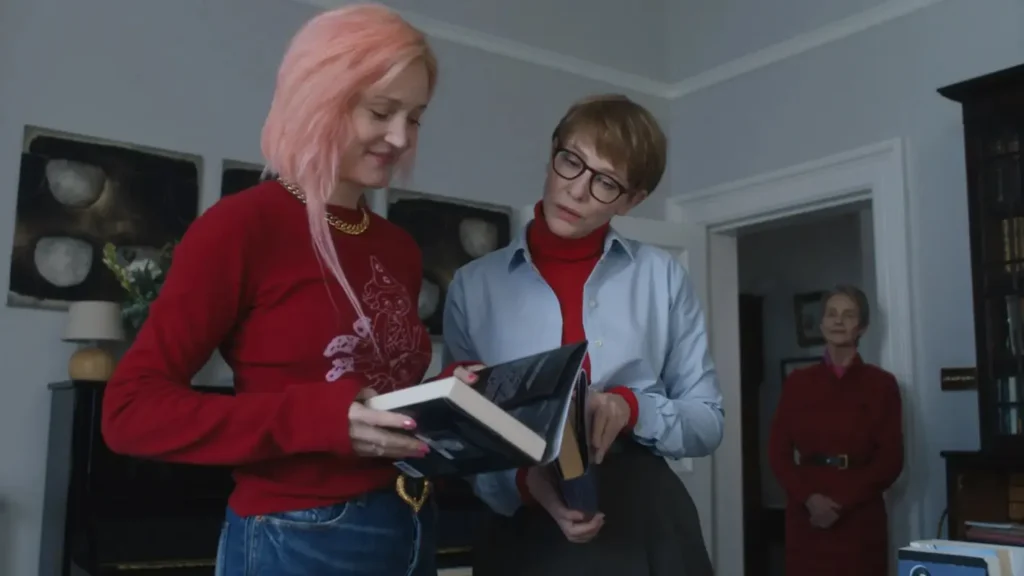
The same is true of the following vignette, in which Rampling’s aloof but presumably loving Mum welcomes her two daughters for their annual afternoon tea. Why, you wonder, do the three get together only once a year when they all live in Dublin? And why aren’t any of them disturbed by this? Who knows, but what a pleasure to sit in awe of Rampling, Blanchett and Krieps, as their disingenuous characters trade falsehoods while politely sipping tea and nibbling dainty pastries. As with the first entry, you almost wish Jarmusch had endeavored to develop it into a feature film.
Alas, that’s not the case with the final tale. It’s not the fault of Luka Sabbat and Indya Moore as Billy and Skye, newly ordained orphans who’ve determined that they never truly knew their parents, but now, in the wake of their deaths, wish they had. So many mysteries that will forever go unsolved. I could relate, given how I’ve amassed dozens of questions I wished I’d posed to my folks when they were alive.
I found the sentiment moving, but the writing, and yes, the acting, never matched the understated humor and emotional depth of its two predecessors. But to be fair to Moore and Sabbat, how tough must it be to follow the triumvirate of Rampling, Blanchett and Krieps? It’s like taking the stage after The Beatles or The Stones. You have no chance of surpassing them. Yet, you’re never bored.
And at times, I was even amazed, mainly by the clever camerawork of Frederick Elmes and Yorick Le Saux. Both lend the film momentum by continually shifting angles, even when the actors are seated on a couch, floor, or around a table. The overhead shots are particularly eye-catching, evocative of watching an intricate chess match from on high. And in many ways, you are, as Jarmusch’s richly drawn characters maneuver awkward, uncomfortable conversations, always careful to conceal their true selves.
It’s not one of Jarmusch’s best films, but it is a must-see for his fans, especially those curious to witness him temper some of his trademark quirkiness with a touch of wistfulness that comes with age. In that respect, “Father Mother Sister Brother” (no punctuation in this case) uncharacteristically tugs at the heart while striking a nerve. But there’s never any doubt that you are experiencing a virtuoso dedicated to making movies his way. They may not appeal to the masses, but for a select few, they are cinematic poetry.
Movie review
Father Mother Sister Brother
Rated: R for language
Cast: Tom Waits, Adam Driver, Mayim Bialik, Cate Blanchett, Charlotte Rampling, Vicky Krieps, Luka Sabbat and Indya Moore
Director: Jim Jarmusch
Writer: Jim Jarmusch
Runtime: 110 minutes
Where: In theaters Jan. 9
Grade: B+