‘All That’s Left of You’ garners hope amid despair
Encapsulating eight decades of Palestinian strife in a 145-minute movie is beyond ambitious, but don’t tell that to multi-hyphen filmmaker Cherien Dabis, whose “All That’s Left of You” comes surprisingly close to pulling it off. Told through the eyes of three generations of a family that’s endured war, racism and multiple slights and humiliations, Dabis vividly captures the cost of having so much snatched from you yet always finding the courage to move on.
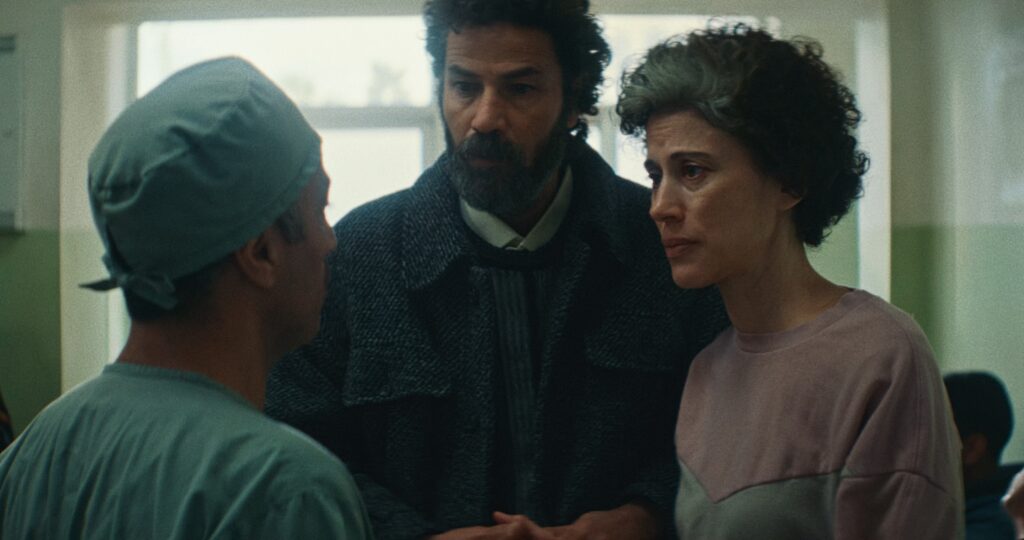
It opens in 1988 with the shooting of Noor (Mohammad Abed Elrahman), a brash teenager caught in the crossfire of Israeli troops violently attempting to dispatch a band of protestors during the First Intifada. Cut to 2022, where we meet Noor’s aged mother, Hanan (Dabis), in tight close-up. She’s about to recount her family’s saga to unseen person or persons seated across from her when Dabis, the writer-director, whisks us back to the onset of the Nakba in 1948.
The setting is a handsome home in the historic and sacred enclave of Jaffa, where Sharif (Adam Bakri), an orchardist, is determined to stand his ground against paramilitary groups seeking to drive all Arabs out of the former Mandatory Palestine. But in what is to become a familiar theme, the fight to hold onto his home and business fails, lands Sharif in a political prison, while his wife, Munira (Maria Zreik), and their four kids, including Sharif’s favorite, Salim, wind up in a refugee camp. We then move ahead to 1978, where Salim (Saleh Bakri, Adam’s brother) has a family of his own, including the ill-fated Noor, a spiteful boy who is slowly becoming radicalized by his embittered gramps, Sharif (Mohammad Bakri, Adam and Saleh’s father). We then come full circle when the timeline advances to 1988 and the shooting of Noor.
That’s the basic outline, but the lifeblood of “All That’s Left of You” is in the details, particularly the father-son dynamics between Sharif and Salim and Salim and Noor, with the gist being that they are very much the Palestinian version of the O’Haras from “Gone with the Wind.” War and occupation have left them with nothing to hold onto but their solidarity. But even that is increasingly under attack from within.
Yes, Dabis simplifies it to the nth degree, but not without wrenchingly putting a human face on people who, through no fault of their own, have had everything, including their dignity, stripped from them. There’s heartbreak practically everywhere you look, reaching its peak in what is arguably the film’s most powerful moment. It occurs when Salim and Noor, in violation of curfew laws, are harassed by a quartet of young Israeli soldiers who purposely make Salim appear a coward in front of his son.
It’s just one scene, but it’s very much a microcosm of the dearth of humanity born of an ancient feud that continues today with the slaughter and destruction in Gaza. It’s in keeping with Sarif’s belief that the Israelis are determined to drive every Arab out of what was once Palestine. And Dabis knows from where she speaks, having spent some of her youth visiting kin in the occupied West Bank.
Much like her breakout film, “Amreeka,” Dabis isn’t so much interested in the politics of the crisis as she is advocating for compassion and understanding in a land where hatred and violence are the order of the day. Her passion is obvious. And even though she often allows her film to slide into cloying melodrama, she never loses sight of her goal: seeking empathy for a people that have long been unfairly vilified. She’s equally determined not to demonize the Israelis. All she is asking is that we take time to ponder the Palestinian side of the story.
It’s very much a call for peace, love and understanding in a land where an eye for an eye is taken much too literally. And what has it gotten either side? Other than massive land grabs, nothing but death and destruction. When will it end?
Salim and Hanan have every reason to be embittered by the shooting of their son, but they unselfishly bestow the greatest of gifts upon an Israeli family. It’s deeply moving, but like everything true and meaningful, it comes at a heavy cost, one that very much proves there’s as much honor in death as there is in life.
Movie review
All That’s Left of You
Rated: Not rated
Cast: Cherien Dabis, Saleh Bakri, Adam Bakri, Mohammad Bakri, Maria Zreik and Mohammad Abed Elrahman
Director: Cherien Dabis
Writer: Cherien Dabis
Runtime: 145 minutes
Where: In theaters Jan. 9 (limited)
Grade: B