‘Wizard’ chronicles Putin’s rise to Russian dictator
Condensing 22 years of Russian history into one 136-minute film is a big ask, and one that co-writer-director Olivier Assayas doesn’t quite pull off. But there’s still plenty to like about his adaptation of Giuliano da Empoli’s novel, “The Wizard of the Kremlin.” And much of that appeal is due to the one-two punch of Jude Law and Paul Dano personifying unperturbed evil as Vladimir Putin and the “Tsar’s” longtime advisor-fixer, Vladislav Surkov.
Like the book, the movie is a slightly fictionalized version of actual events that followed the collapse of the Soviet Union in December 1991. It’s real people doing real harm to a burgeoning democracy that never stood a chance against a cadre of power-seeking connivers. Chief among them, superpredators Putin and Surkov. For dramatic purposes, the latter has been rechristened Vadim Baranov to enable Assayas and fellow scenarist Emmanuel Carrère to alter history by depicting him as a Zelig-like figure front and center of every major event in recent Russian history, from the Chechen War, to 2000’s Kursk disaster, to a series of suspicious apartment bombings in 1999 that may have been false-flag operations aimed at boosting Putin’s popularity.
The rest is pretty much as it happened, making “Wizard” a must-see for the wonks eager for a tongue-in-cheek peek into how authoritarian sausage is made. And those folks may find it unsettling how closely Putin’s push for power parallels what is occurring in our own nation as we speak. We’re even offered a brief glimpse into Putin’s notorious Internet Research Agency, which in 2016 flooded Twitter and Facebook with disinformation favorable to Donald Trump.
It’s hardly the only example of the flick trolling Trump. Another is the cheeky decision to tack “game-show producer” on Baranov’s resume. It’s one of the few instances in which Assayas and Carrère stray from fact. True, Baranov’s alter ego, Surkov, was heavily involved in public relations, but he was never a TV producer or a theater director like Baranov. And I’m betting Surkov never had a girlfriend as hot as Baranov’s on-again, off-again squeeze, Ksenia (Alicia Vikander).
Like many elements in “Wizard,” their relationship seems as random as the fitful stabs at humor, mostly sight gags featuring the aged, often drunk Boris Yeltsin. Yet “Wizard” is often immersive, precisely capturing the look and feel of turn-of-the-century Russia, with neighboring Latvia serving as a convincing substitute and sophisticated CGI recreating the Kremlin.
But it’s the snowy Moscow countryside where the film begins, with Baranov summoning a Yale University professor (Jeffrey Wright) to his remote estate to discuss a recent article the visitor has written about him, and to share what they discover to be a mutual appreciation of Soviet author Yevgeny Zamyatin, whose “We” became an inspiration for George Orwell’s “1984.”
Their encounter on a bleak, wintry afternoon in 2019 acts as a clunky framing device, enabling Baranov to recount his life story, beginning with those halcyon, albeit somewhat reckless, days in the early 1990s, a time of brief optimism, as communism flirted with democracy. This is when Batanov dedicates himself to the theater, with Ksenia his seductive muse. It’s also around this time that Batanov crosses paths with his high school chum, Dmitri Sidorov (an excellent Tom Sturridge), a fledgling oligarch whose rags-to-riches story Batanov wants to showcase in his next play.
The fictitious Sidorov also quickly catches the opportunistic eye of Ksenia, who, like us, recognizes greater potential in hitching her wagon to the fun-loving Sidorov rather than the dull, pedantic Batanov. The couple’s inevitable split leaves Batanov heartbroken but also more incentivized to transition into a high-stakes player in “the new Russia,” which leads to his being courted by Yeltsin’s confidante, Boris Berezovsky (a perfectly smarmy Will Keen). As the proprietor of Russian State TV, Berezovsky enlists Batanov in a scheme to convince Putin to abandon his dream job as head of the FSB (Russia’s secret police) and emerge as the latest in a revolving door of prime ministers under President Yeltsin. There’s something about Batanov and his vision of Putin becoming as influential as Stalin that convinces Russia’s top spy to give politics a whirl, but only if he’s permitted to call all the shots. And the rest, as they say, is history.
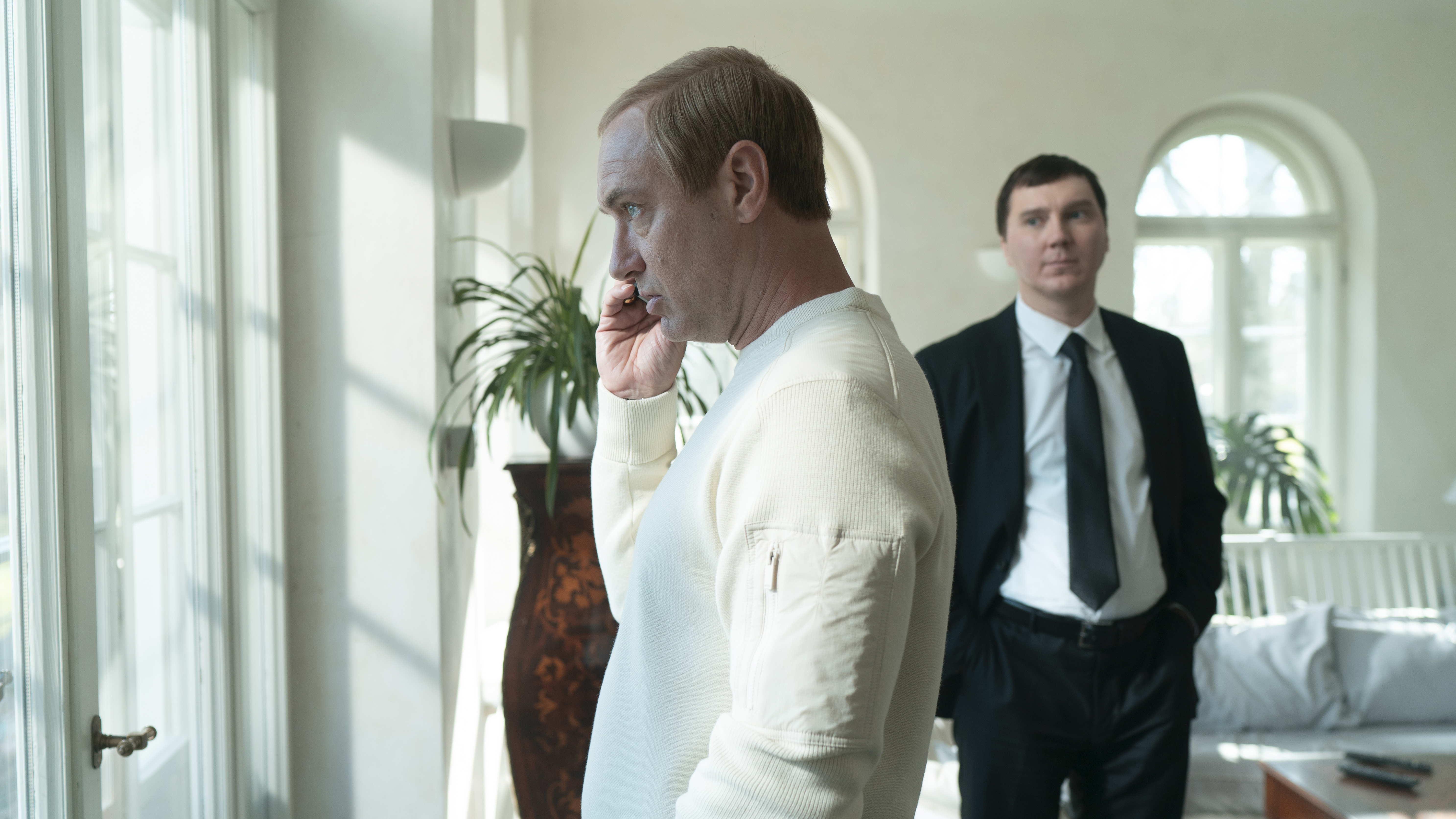
How Baranov engineered Putin’s ascension is the lifeblood of “Wizard” and the ultimate reason to see it. Well, that, and the excellent performances by a doughy, purposely lackluster Dano and a buff, balding Law, each closely resembling their real-life counterparts. Their scenes together are sparse, but when they do join forces, “Wizard” turns vibrantly alive. When they aren’t centerstage, it can be a bit of a slog.
Part of that is owing to what feels like a rushed storyline, leaving little time to absorb the subtle personality traits of men who’ve readily swapped their souls for money and power. Some of that harried pace can be attributed to the film’s runtime being trimmed by 20 minutes after premiering last summer in Venice. Yet, it seems counterintuitive. What the story really needs is more time, making it an ideal candidate for a six- or eight-part series on Netflix.
What’s here, though, delivers just enough intrigue to satisfy those wanting to better understand Putin’s rise, as well as the ease with which authoritarians are able to manipulate the gullible masses. No doubt the key here was the slow, deliberate path Putin followed to the top. There was none of the bombast of Hitler or Mussolini; just a calm, measured ruthlessness that has led a once-mighty nation and its stalwart populace to rue the day Putin took charge.
Even Baranov begins to have second thoughts after Putin’s thirst for dominance becomes too much in the wake of Russia’s takeover of Crimea and the massive fortune expended on hosting the Sochi Winter Olympics in 2014. Both events were boons to Putin and his coterie of sycophantic oligarchs, but did nothing to elevate the spirits or the incomes of everyday Russians. Sounds a lot like current times in the U.S., doesn’t it, with the construction of an opulent ballroom taking precedence over making life more affordable for the little guys? We even have the Olympics coming here in 2028, a global celebration that will no doubt please the upper one percent but do nothing to solve L.A.’s homeless problem.
As I mentioned, the similarities are eerie. And Assayas (“Personal Shopper”) has obviously conceived his film as a wake-up call to Europeans and Americans alike, many of them schmoes too preoccupied with their own lives to notice how their futures – and those of their children and grandchildren – are being sacrificed by a handful of self-serving billionaires and grifting politicians. And as was the case with Russia, it’s all happening so gradually that you barely notice the incremental erosion of our rights and freedoms. It’s that very reason that should impel you to set off to see the “Wizard.” It won’t grant you brains, heart, or courage, but it will surely convince you to pay a bit more attention to those deceitful scoundrels behind the curtain.
Movie review
The Wizard of the Kremlin
Rated: R for language, graphic nudity, a grisly image, some sexual material, violence
Cast: Paul Dano, Jude Law, Alicia Vikander, Tom Sturridge, Will Keen and Jeffrey Wright
Director: Olivier Assayas
Writers: Olivier Assayas and Emmanuel Carrère
Runtime: 136 minutes
Where: In theaters May 15
Grade: B-