In ‘Ask E. Jean,’ Carroll gets the best of The Donald
For more than two decades, journalist E. Jean Carroll thoughtfully, and often entertainingly, doled out advice to readers through her monthly Elle column “Ask E. Jean.” But that all ended the minute she summoned the courage in 2019 to confront the lasting guilt over allegedly being raped by one Donald J. Trump in the winter of 1995-96 at the chic Manhattan department store, Bergdorf Goodman.
Not long after sharing that long-suppressed memory with the world in her memoir, “Hideous Men,” Carroll was given the ax, presumably at the behest of an aggrieved Trump, the sitting president. Elle asserts her dismissal was due to downsizing, but in Ivy Meeropol’s fascinating documentary, “Ask E. Jean,” Carroll insists that it was the work of the man she says not only assaulted her but also publicly defamed her in the wake of her book’s publication.
Two juries unanimously agreed, to the tune of $88 million, that the resident of 1600 Pennsylvania Ave. was liable, although he has yet to remit a dime. But after observing the resilience and fortitude on display in Meeropol’s profile, you get the sense that it was enough for Carroll just to be believed. And Meeropol’s film will likely further heighten Carroll’s reputation, as she not only stands up for herself but also for the millions of other survivors who kept silent for too long before #MeToo.
In nearly every frame, Carroll projects dignity, humor and a renewed confidence won through unblinkingly staring down her worst fears. But “Ask E. Jean” is so much more than temporary relief from Trump Derangement Syndrome; it’s also a look back at an amazing life filled with numerous triumphs, from winning Miss Cheerleader USA in college to blossoming into a celebrated TV talk-show host to offering a compassionate shoulder to cry on for the thousands of women she helped through Elle.
Among the plethora of archival clips, including an appearance on the game show prophetically titled “To Tell the Truth,” the most haunting might be the day she struggled to refrain from relating her own experience in the Bergdorf changing room while comforting a fellow rape victim on the TV version of “Ask E. Jean.” A close second might be the excerpts from the deposition she gave to Trump attorney Alina Habba, who was ruthless in asking Carroll to relive every gory detail of the evening she had the misfortune of running into Trump at Bergdorf Goodman.
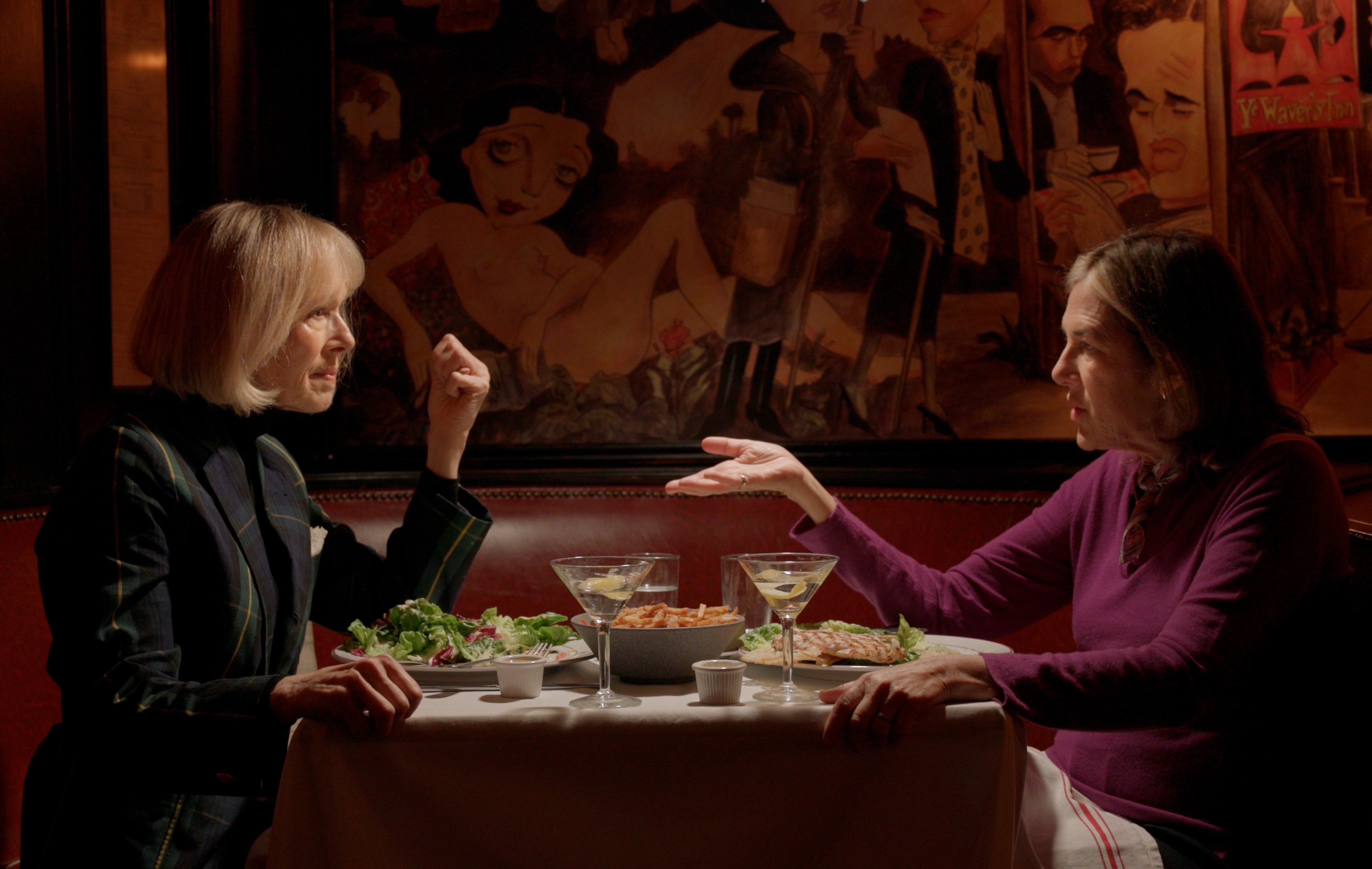
At times, her testimony about Trump’s piggish, “grab them by the pussy” behavior makes you squirm. It’s so humiliating for Carroll that you fully comprehend why so few rape victims report such crimes. Admirably, Carroll remains calm, cool and assertive. It’s the same during scenes in which she and her best friend, Lisa Birnbach, chat across a table, reliving the worst day of Carroll’s life, noting how her decision to tell Birnbach what had happened within hours of the attack played a large role in establishing her credibility with the jury.
Although her sexual assault is the focus, “Ask E. Jean” also elicits its fair share of fun, courtesy of Carroll’s endearing eccentricity as well as her astute observations on the lopsided state of male-female relationships, an equation she seeks to even out by empowering the lives of women at home and in the workplace. What’s sad is that for too long, Carroll failed to follow her own advice, especially when it came to Trump, whose power and pull she rightfully feared.
Now 82, still beautiful, still stylish, and still witty and whipsmart, Carroll is a delight to hang with. And for the uninitiated, like myself, it’s difficult not to be impressed by her colorful and eventful life, a career that began with a fixation on Dear Abby and Ann Landers as a child. Following in their footsteps was a dream come true, one that Carroll is still bitter about being robbed of, ironically, for exercising her First Amendment rights. It’s almost as infuriating as Trump labeling her a liar.
“Not my type,” he’s often said of his accuser. But how can you not laugh when, during his own deposition, Carroll’s attorney, Roberta Kaplan, confronts Trump with a 1987 photo in which he misidentifies Carroll as his second wife, Marla Maples, whom he admits he finds “attractive.” As if the moment can’t get any more surreal, he fails to acknowledge that the woman to his immediate right is his first wife, Ivana. Kaplan believes that damning slip-up sealed Trump’s fate.
Will Carroll ever see the $88 million she’s owed? Or more pressingly, will Trump’s rabid MAGA followers ever stop trolling her with insults and death threats? I’m sure this isn’t how she envisioned living out her final years. But like every other detour in her life, she’s been able to find humor in the ridiculousness of the situation.
Half the country hates her, and half loves her. For E. Jean Carroll, that’s totally fine. It’s merely a vindication of her continued relevancy as both a sage and as a woman unafraid to stare Trump in the face and tell him, and the world, what he did to her was not OK. Her only regret is that she didn’t speak up sooner. And where would our country be now if she had? Some food for thought, courtesy of a woman fully aware that her greatest power rests in her truth.
Movie review
Ask E. Jean
Rated: Not rated
Featuring: E. Jean Carroll, Lisa Birnbach, Roberta Kaplan and Carol Martin
Director: Ivy Meeropol
Runtime: 91 minutes
Where: In theaters May 21 (limited)
Grade: B+