You’ll want to get locked up with ‘Ghost’
I say with utmost confidence that you’ve never seen a movie as unique as Joko Anwar’s “Ghost in the Cell.” You name it, you’ve got it in this genre-melding tale in which hardened prisoners eagerly partake in interpretive dance, name-drop Kierkegaard, unearth political corruption, battle powerful supernatural forces and vanquish a sadistic guard.
Brimming with intense action, droll comedy, and unnerving terror, it’s a jaw-dropping, head-scratching blast that seldom loses its mojo. From its brutally violent opening to its peaceful, easy ending, you remain firmly in Anwar’s zany grip. Some, I’m sure, will freak out over its gorier moments, of which there are many. But for those who value originality, this is the smart, tongue-in-cheek bloodbath you’ve long been itching to dip a toe in.
Not only is it visually stunning, it also boasts a standout star turn by Abimana Aryasatya as Anggoro, the heart, brains and soul of a story meant not just to entertain, but also to propagate the notion that every soul on earth has a purpose. In Anggoro’s case, that would be to unite the prison’s two lowliest factions in ridding the hoosegow of an evil spirit that is killing off the general population with impunity.
And what a kick it is to learn that the only way to accomplish this exorcism is to convince the rogues’ gallery of killers and thieves to expunge their inherent anger and hostility through prayer or, yes, dance. The latter sets the stage for a side-splitting scene in which two dozen inmates attempt to learn Madonna-esque voguing, hoping to generate enough exuberance to scare off the demons.
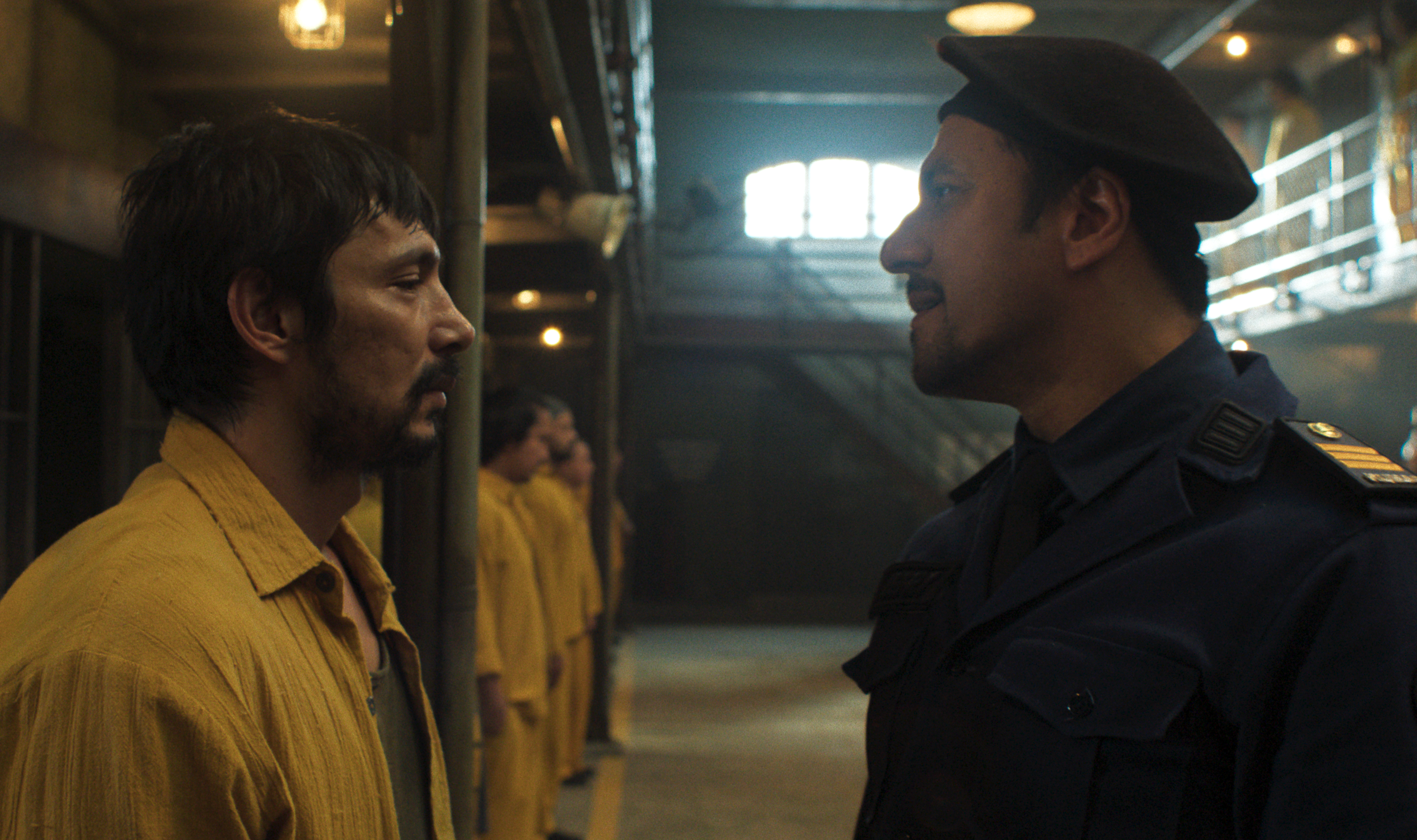
It’s matched only by a terrific bit in which Anggoro and his chief nemesis, the sadistic head guard Jefry (Bront Palarae), engage in a heated debate over the merits of Alfred Adler versus Sigmund Freud. It’s the sort of absurd exchange you’d expect in a Woody Allen or Mel Brooks production, not in a flick built on an odd mix of horrific violence and kumbaya camaraderie.
It not only works but also showcases Anwar’s encyclopedic knowledge of film history. Like an Indonesian version of Quentin Tarantino, he freely mixes genres while mocking their precepts in a stagy, loony style, including a “Crouching Tiger, Hidden Dragon”-esque martial arts display in the cellblock corridor. We even get a precipitous two-story faceplant to rival the recent metaphorical one Missouri Sen. Eric Schmitt suffered. Ouch!
At times, all the mayhem and social commentary threaten to overshadow the central ghost tale, but to Anwar’s credit, he never strays for long. And good thing, because he has a compelling tale to tell involving corporate greed, a two-tiered system of justice, and a rich vein of negative karma triggered by government-sponsored corruption.
And that’s where the film starts, with Dimas (Endy Arfian), a young business reporter in Jakarta, working a major story about an illegal nickel mining operation in Borneo that has led to the deaths of more than two dozen workers. It’s not giving too much away to say Dimas returns from the scene of the crime, unknowingly afflicted by parasitic spirits who embark on what becomes a lengthy retribution campaign, starting with his paper’s ill-tempered publisher.
Falsely convicted of his savage slaying, Dimas is sent to prison along with those mass-murdering ghosts whose motives aren’t revealed until late in the picture. But the why is never as impactful as the how. Anwar ensures that by neatly spacing the gruesome slayings among enlightening instances of character development, with Anggoro, Jefry, and the milquetoast Dimas each getting his moment to shine. But by far the most indelible of the bunch is the Gollum-like Tokek (a superb Aming Suandhi), as Dimas’s terrifying cellmate.
He’s truly sinister, emitting viper hisses as he threatens Dimas with sodomy and worse. The thought of having to pick up the soap with him next to you in the shower (yes, there is that scene) is chill-inducing. Even Anggoro might be powerless to save Dimas from this freak. But it’s thrilling watching him try. And what Aryasatya accomplishes with such a clichéd character – the good-guy victim of circumstance who doesn’t belong here – is impressive, taking full advantage of his quiet intensity, rugged looks and Adam Driver-esque vibe.
In fact, the entire cast is top-notch, but Anwar’s clever writing and fertile imagination are what imbue “Ghost in the Cell” with so damn much elation. It also carries uncanny relevance, in light of an expose this week concerning the Cibinong Detention Center near Jakarta. The scandal mirrors a subplot here about wealthy, politically connected prisoners being housed in “luxury” cells outfitted with TVs, access to the Internet, and a hall pass to leave the premises whenever they wish.
And how can you not think about similar perks granted to convicted child sex trafficker Ghislaine Maxwell by U.S. Attorney General Todd Blanche? So, a big fat A for topicality. That’s just one of myriad reasons why “Ghost in the Cell” is so scary good. You’ll laugh, you’ll recoil and you’ll walk away amazed. But by all means, walk away happy. Cuz, if you don’t – in keeping with the story’s central motif – you might end up like Dimas’ ill-fated editor: disemboweled, filleted, and tied by his entrails to a slow-turning ceiling fan. Appropriate, given the movie aims to give horror a fresh spin. Purists may quibble, but me, I’m thoroughly sold on “Cell.”
Movie review
Ghost in the Cell
Rated: Not rated
Cast: Abimana Aryasatya, Bront Palarae, Aming Suandhi and Endy Arfian
Director: Joko Anwar
Writer: Joko Anwar
Runtime: 106 minutes
Where: In theaters Oct. 2 (limited)
Grade: B+