‘Harlem’ a stunning peak at Black history
The only discernible disappointment in the astounding documentary “Once Upon a Time in Harlem” is that most of the biggest stars of the Harlem Renaissance didn’t live long enough to attend what was perhaps the most elite cocktail party in Black history. Missing were Langston Hughes, W.E.B. Du Bois, Countee Cullen, Marcus Garvey, Zora Neal Hurston, Augusta Savage and Bill “Bojangles” Robinson.
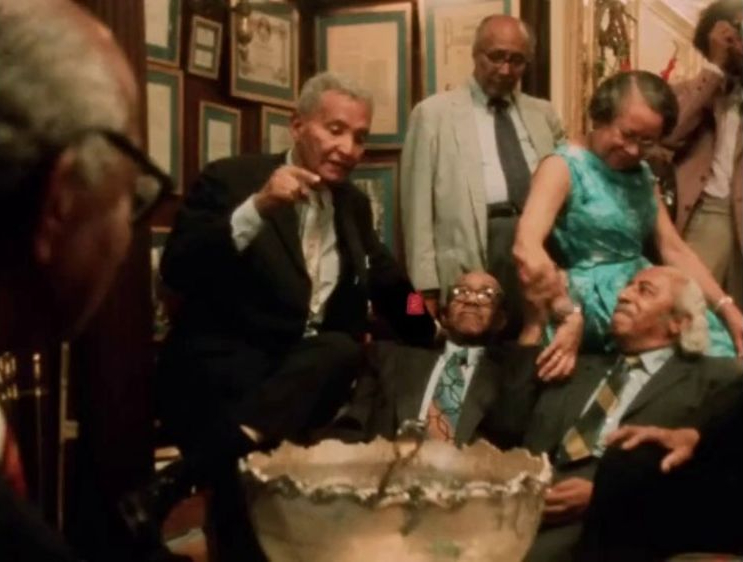
Yet their presence is eerily palpable among the roughly three dozen Renaissance survivors attending this extraordinary soiree, held on August 6, 1972, in the well-appointed Manhattan townhouse of jazz great Duke Ellington. All were there at the invitation of filmmaker William Greaves, who had the tremendous foresight to bring along a film crew that included his son David. He planned to use the 16mm footage in his 1974 documentary “From These Roots,” but for reasons that remain unclear, he didn’t.
After his death in 2014, his widow, Louise, wisely vowed to restore and assemble the priceless archive into a film marking the cultural movement’s centennial. To handle it, she looked no further than David to complete what his dad started 50 years earlier. And what a gift it is, with luminaries such as artist Aaron Douglas, actor Lee Whipper and musician Eubie Blake doning their Sunday best to attend what’s best described as a star-studded high school reunion.
Boiling the four-hour, alcohol- and nicotine-fueled event down to 100 minutes must have been agony for the younger Greaves, but what’s here delivers a giant chef’s kiss, a living history lesson in which Renaissance alums reminisce, pontificate, analyze, and debate their invaluable contributions not just to Black pride but to the creative arts in general. It couldn’t arrive at a more vital time, either, as the Trump administration actively seeks to erase Black history.
What strikes you most is how timeless this time capsule feels. It’s like it was filmed yesterday, not 54 years ago. Yes, the fashions – turtlenecks, lace cocktail dresses and mustaches of various success – look archaic, but the people and their insights and opinions are oh so contemporary. As they speak of departed legends like Cullen, Garvey, Du Bois and Hughes, you are left to ponder how bereft our society would be without their contributions.
Among the attendees, I was most intrigued by Blake, Douglas and the lettered intellectual Richard B. Moore. Their many anecdotes are riveting, both funny and sad. You also admire the fire in Cullen’s widow, Ida Mae, who angrily protests that the others are downplaying her husband’s significance. What an advocate, quieting the other guests with her stirring outburst.
Another icon complains that too much of the conversation is focused on the artists and not the reformers like Garvey and Du Bois, bitter enemies who shared the common goal of equality at a time when Blacks were targeted by supremacists, be it through lynchings or race riots like the Tulsa Massacre of 1921. Others remind us that Harlem became the epicenter of what would become the Civil Rights Movement, drawing Blacks from across the country to what they believed was a “Mecca.”
You cannot help but sigh when Blake, chatting with Whipper about a classless, racist act committed by Charles Lindbergh, naively replies, “Well, that was before Martin Luther King. It’s all right now.” Oh, don’t we wish. Alas, we’re not treated to Blake sitting down at Ellington’s piano, but acclaimed photographer James Van Der Zee does, softly playing a melodic lilt.
Don’t expect to see Ellington, though. He picked the worst day to be too ill to join the throng downstairs, but he’s present in several photographs adorning his parlor. He also appears in archival clips as invaluable to the story as the recitations of the works by some of the poets in attendance. Not to mention, a remarkable contribution from the 95-year-old Whipper, who recites from memory his long soliloquy from the 1943 film “Mission to Moscow.”
Disagreements arise when it comes time to define the legacy of the Harlem Renaissance. Poet Arna Bontemps sums it up as “a prism of reflecting all of the Black experience from the beginning to the present.” Journalist George Schuyler says simply, “It was an awakening of people who wrote and thought.” Me, I’d say it was a serendipitous assemblage of forward-looking geniuses whose like will never be seen again. Making “Once Upon a Time” not just a film, but a treasure to be cherished, savored and never forgotten.
Movie review
Once Upon a Time in Harlem
Rated: PG-13 for some disturbing images, strong racial language, smoking and brief partial nudity
Featuring: Hubie Blake, Aaron Douglas, Richard Bruce Nugent, Richard B. Moore, Lee Whipper, Arna Bontemps and George Schuyler
Director: David Greaves
Runtime: 100 minutes
Where: In theaters Oct. 23 (limited)
Grade: B+