Economic divide drives ‘Possible Love’
Lee Chang-dong’s miraculous “Burning,” an incendiary treatise on class, economics and envy, remains seared in my mind a full eight years after its release. Finally, Lee delivers his much-anticipated follow-up, “Possible Love,” a similar parable built around the 10th Commandment: “thou shalt not covet…” In myriad ways, the two films form a whole in which Lee explores the ever-widening gap between South Korea’s haves and have-nots.
In “Burning,” a poor farmboy is driven to murder by an uncontrollable jealousy fanned by a rich playboy who becomes his rival for a beautiful woman. Here, two couples, one wealthy and the other decidedly working class, awkwardly embark upon what the wives believe is friendship, but might be closer to a toxic symbiosis. In both scenarios, the story reveals how the yearning to connect can sometimes lead to delusion, transactionality and kowtowing to people who couldn’t care less about you.
Lee and his “Burning” co-writer, Oh Jung-mi, brilliantly unspool the narrative, starting, appropriately enough, at a funeral. That’s where fledgling documentarian Ye-ji (“Parasite’s” Cho Yeo-jeong) totes her camera to chronicle the reverberating effects of a bloody labor dispute that cost dozens of strikers their jobs. The aftermath has proved so devastating that one worker has taken his life, which brings Ye-ji to the mortuary.
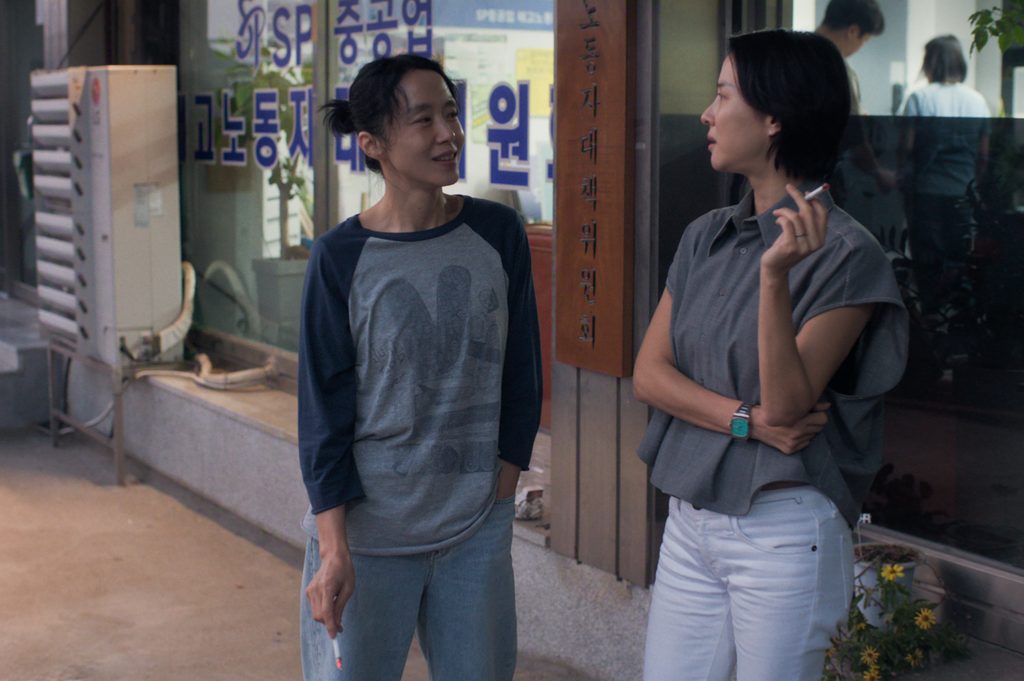
While interviewing mourners, she meets Mi-ok (a sensational Jeon Do-yeon), the tenacious, blindly optimistic wife of Ho-seok (Sul Kyung-gu), the departed’s friend and co-worker. When Mi-ok and Ho-seok begin quarreling over his drinking, something he promised not to do in public, Ye-ji moves in with her camera to record the spat. But something about Mi-ok, something we also see, compels Ye-ji to chat her up. Despite Ye-ji’s much higher status as the wife of a wealthy businessman, they instantly hit it off and begin spending more and more time together.
At first, Mi-ok doesn’t recognize Ye-ji’s station, but her stylish wardrobe and chic accessories eventually give it away. Mi-ok even suggests to Ye-ji that dressing down might make it her blue-collar subjects more apt to open up. To which Ye-ji happily complies. It’s around this time you start to wonder about the sincerity of Ye-ji’s motives. Might she, consciously or subconsciously, just be using Mi-ok to gain access? Her husband, Sang-woo (Zo In-sung), suspects so, an intimation she shakes off but doesn’t entirely dismiss.
Thus, the stage is set for a fascinating sociological exploration in which a series of seemingly everyday occurrences reveals fissures in the women’s relationship that culminate in a wild, crazy weekend at Sang-woo’s refined coastal estate. The results are undoubtedly compelling, but also a tad predictable, as the wives begin to long for what the other has: Ye-ji, a comfortable, worry-free lifestyle with a rich, hunky husband; and Mi-ok, a fairly solid marriage and a quiet, well-mannered 10-year-old son in Cheol (Jeong Seop). The husbands aren’t immune, as each is drawn to the other’s wife for different reasons.
At a butt-numbing 164 minutes, Lee takes his time getting to the point, but you don’t really mind, given the high caliber of his ensemble, led by Sul’s Ho-seok, a once-proud man who internalizes the pain and shame of having his dignity and self-respect literally beaten out of him by his former employer’s goons. Sul appropriately portrays Ho-seok as a zombie; his once-fiery spirit forever extinguished by a system that treated him like a commodity more than a person. As Ye-ji accurately notes, “You can see the sadness behind his eyes.”
It’s the perfect contrast to the undying sunniness and warmth Jeon projects as Mi-ok, who, like Ho-seok, comes from humble beginnings and fully expects to maintain that station. That is, until she meets Ye-ji and the tall, athletic Sang-woo, whom she thinks resembles Steve Jobs, though she means the confident way he carries himself more than any physical likeness. Only slightly less infectious is Cho, who portrays Ye-ji as a natural beauty whose elite standing shows in her quiet sophistication.
The challenge for all four leads is selling us on their authenticity, or lack thereof. Are the couples really getting along, or are they just pursuing a personal agenda, whether it’s Ye-ji’s film or Mi-ok’s thirst for autonomy? It’s only a matter of time before it boils over. As they say, it’s all about the money; who has it and who doesn’t. And can a tenuous friendship survive it?
The resulting strife lands us in a highly uncomfortable place, a constant in Lee’s films. As in “Burning,” both he and Oh possess a remarkable understanding of human nature and how income disparity has made it nearly impossible for people like Ye-ji and Mi-ok to sustain a friendship across an ever-widening economic divide. Above all, “Possible Love” is a rare movie that dares to address sensitive issues with humor and heart, much like Park Chan-wook’s underappreciated “No Other Choice.”
The two films overlap, most notably in their focus on the trickle-down effects of corporate buyouts and restructuring programs that favor cost-cutting over loyalty. Ultimately, that’s what Ho-seok can’t accept. Certainly not after giving so much of himself, as a welder, to a company he believes ultimately destroyed his life simply because he and his co-workers sought a more liveable wage.
The outcome, as you’d expect with a Lee movie, is as stirring as it is profound. And even though it’s set in Korea, what’s happening there is also happening here. As made clear Tuesday night when millions of Americans raised a collective middle finger to a government they believe no longer respects or cares about them. Love? Is it even possible in this era of unmitigated cruelty? Lee affectingly leaves it for us to decide.
Movie review
Possible Love
Rated: R for language, some sexuality and nudity
Cast: Cho Yeo-jeong, Jeon Do-yeon, Sul Kyung-gu, Zo In-sung and Jeong Seop
Director: Lee Chang-dong
Writers: Lee Chang-dong and Oh Jung-mi
Runtime: 164 minutes
Where: In theaters and on Netflix
Grade: B+