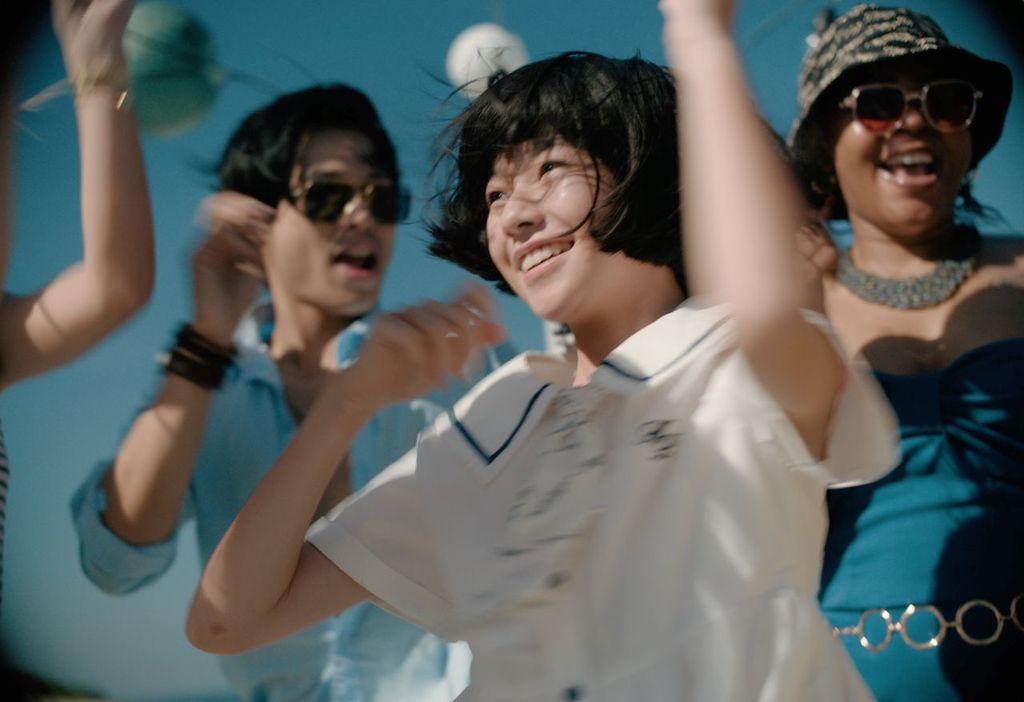
Beautiful ‘Renoir’ paints coming-of-age masterpiece
Death is a concept 11-year-old Fuki Okita has so little grasp of that she’s flippantly written a school essay titled “I’d Like to Be an Orphan.” It’s a case study on being careful what you wish for, as the Reaper fixes to come calling on her family in the mesmerizing coming-of-age tale “Renoir.”
Everything about this understated jewel feels lived in, as it should be, given that writer-director Chie Hayakawa lost her father at the same age in 1987, coincidentally the same year I lost mine, albeit on opposite sides of the globe. And a great deal of the intrigue “Renoir” creates lies in the vast differences between East and West cultures. Like, did you know that in the 1980s, when “Renoir” is set, as a rule, doctors in Japan did not inform their terminally ill patients that they were going to die?
No wonder Fuki, played with amazing grace by the fabulous newcomer Yui Suzuki, comes to believe death is a subject often whispered, thus further fueling her insatiable curiosity to understand its power. But she’ll receive no assistance from her parents, who are growing increasingly estranged as her dad (Lily Franky, so great in “Shoplifters”) weakens and her mother (Hikari Ishida) implodes from the residual stress. They’ve basically left Fuki to her own devices, so desperate for affection that she comes dangerously close to falling victim to a pedophile grooming her through a telephone dating service that’s become her only comfort.
The beauty of Suzuki’s performance lies in how she renders Fuki stoic on the outside while using posture and facial expressions to convey an escalating inner turmoil, caught in a prepubescent purgatory, somewhere between childish naivety and adult disillusionment. It’s just one summer, but to her it may as well be three lifetimes, as friendships come and go and emotional stability frays. Yet, her intuition is razor sharp, particularly when it comes to her mother’s not-so-secret affair with a married anger-management instructor (Ayumu Nakajima).
The vividness Hayakawa instills can be directly attributed to her having lived this scenario. Now 39, she clearly recalls every detail from the most traumatic chapter of her youth, and presents it in a manner that’s universally relatable. Fuki’s growing pains recall our own, particularly the deflating realization that not everyone can be trusted, including her parents. If she’s going to cope, she must fend for herself while seeking a means to channel her guilt, confusion and impending grief.
It’s not lost upon us that Fuki’s budding fascination with telepathy and hypnosis is all part and parcel of a quest to solve life’s more complex mysteries. Like, why are adults unable to be honest with themselves? Why are so many suppressing their fears? And why do they selfishly hurt one another by flagrantly twisting the truth?
Hayakawa has said that the inspiration for “Renoir” (a tribute to the French impressionist whose pastoral paintings soothe both her and Fuki) is rooted in her concerted effort not to repeat her parents’ mistakes with her own kids. And it’s not just the obvious miscues, such as her mother’s rage and denial, but also the little things, like her father’s insistence on bringing the office to his hospital bed, as well as the petty callousness of his coworkers making light of the situation.
To be sure, there are good times, too, most notably the day her father feels well enough for an excursion to the track to watch the horses run. It becomes their last meaningful connection and one that inspires Fuki’s love of all things equine. It’s a tender moment perfectly executed without a hint of sentimentality.
It’s utterly in keeping with Hayakawa’s mission to keep it organic, ensuring our involvement, even when she stubbornly refuses to spell things out, like a recurring motif involving bridges symbolizing Fuki crossing over. It can be frustrating, but the payoff is considerable if you commit to her unconventional style in which scenes don’t always immediately connect. What initially presents as disparate ultimately fits together, much like the pieces of a puzzle.
No, it’s not a conventional watch, but it’s assuredly a rewarding one in which Hayakawa leads us into dark places, not to exploit, but to underscore the remarkable resilience of children. Fuki proves her strength repeatedly, with hutzpah and resolve. She’s as tough as nails, evidenced by her inability to cry. But thanks to Suzuki’s evocative performance, Fuki is just cuddly enough to access the deepest recesses of your heart.
Movie review
Renoir
Rated: Not rated
Cast: Yui Suzuki, Hikari Ishida, Lily Franky, Ayumu Nakajima
Director: Chie Hayakawa
Writer: Chie Hayakawa
Runtime: 120 minutes
Where: Currently in theaters (limited), going wider in June
Grade: B+